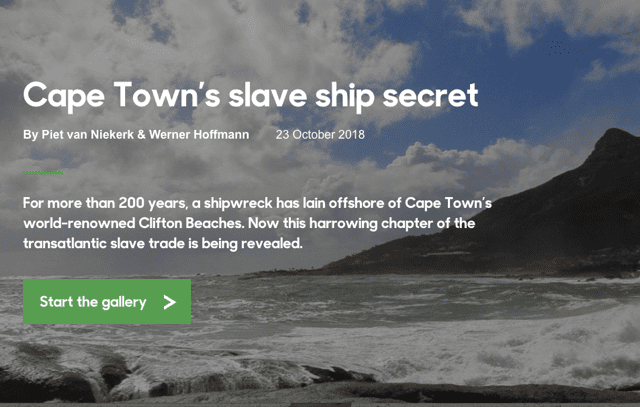
The São José was sailing from Mozambique with a cargo of more than 400 enslaved persons when she encountered rough seas near Clifton (“under Lion’s Head) at night. Tragically, the sea became so rough that the ship wrecked, with more than 200 enslaved individuals perishing in the violent waves.
The event is the subject of a recent BBC Gallery feature with documentary videos produced by creative agency Content Cows in the UK under the editorship of former South African journalist Piet van Niekerk and videographer Werner Hoffmann. It can be viewed here.
The São José possibly represents the first known shipwreck with enslaved Africans on board to be identified, studied and excavated. The exhibition, tells the story of the “human cargo” – the people who were violently uprooted from their homes in Mozambique, to suffer displacement, disaster and death on the shores of the Cape of Good Hope more than 200 years ago.
Diligently excavated, conserved and prepared
The objects of this trans-Atlantic slave voyage have been diligently excavated, conserved and prepared. The artefacts – never seen before in South Africa – recovered from the wreck site form the central element of the exhibition. They tell the story of the ship, its owners, captains, and the voyage that led to its destruction on a Cape shore. A large interactive experience of the wreck site, created by the Smithsonian National Museum of African American History and Culture (NMAAHC) will also be on display.
“Bringing into memory, the story of the São José, within this global context is a significant and remarkable project. This is more than an African, American, Mozambican or European story. This story speaks more about our shared histories, than the constructed notions of separateness perpetuated in, and throughout history,” said Iziko Chief Executive Officer, Ms Rooksana Omar.
Iziko and its partners, who are involved in the Slave Wrecks Project, have been studying and working on the São José wreck site since 2012. The (Slave Wrecks) Project combines research, training and education to build new scholarship and knowledge about the study of the global slave trade, particularly through the lens of shipwrecks. Further research for this project was funded by the US Ambassador’s Fund for Cultural Preservation. The funding awarded in 2016 enabled the continued conservation and fieldwork of the slave ship and wreck site, in South Africa, and has empowered a new generation of young South Africans to work on archaeological vestiges like the slave wreck, São José.
“Cultural heritage endures as a reminder of the contributions and historical experiences of humanity. By taking a leading role in efforts to preserve cultural heritage, the US shows its respect for other cultures,” said US Consul General in Cape Town, Ms Virginia Blaser.
The Slave Wrecks Project (SWP) is a long-term, trans-continental research collaboration between six core partners, including Iziko Museums of South Africa, the Smithsonian’s National Museum of African American History and Culture), George Washington University, the South African Heritage Resources Agency, the US National Park Service, Diving With a Purpose, and the African Center for Heritage Activities.
The story of the São José, once forgotten as a footnote in history for nearly two centuries, will now be brought back into collective memory. The stories of those enslaved on board are represented by the collaborative work of researchers and scholars from Mozambique, South Africa, Brazil, Europe and the United States. This exhibition Unshackled History: The Wreck of the Slave Ship, São José, 1794 will become a permanent fixture at the Iziko Slave Lodge, with regular updates envisaged as the project progresses.
The Iziko Slave Lodge is open Monday to Saturday from 09:00 until 17:00.